
Pharmacist Limits Configuration
Section Purpose:
This documentation describes the pharmacist limits configuration – a tool that enables setting minimum and maximum doses of nutrients and electrolytes, which are then used during prescription verification.
Basic Information
Section titled “Basic Information”Pharmacist limits configuration is a specialized setting available to pharmacists that allows defining safe dosage ranges for nutrients and electrolytes. These limits are used in the pharmacist view during prescription verification.
Application
Section titled “Application”The set limits are visible and utilized in the verification tab in the pharmacist view. When reviewing a prescription, the system automatically highlights values that exceed the established limits, enabling quick identification of potential dosing issues.
Configuration Structure
Section titled “Configuration Structure”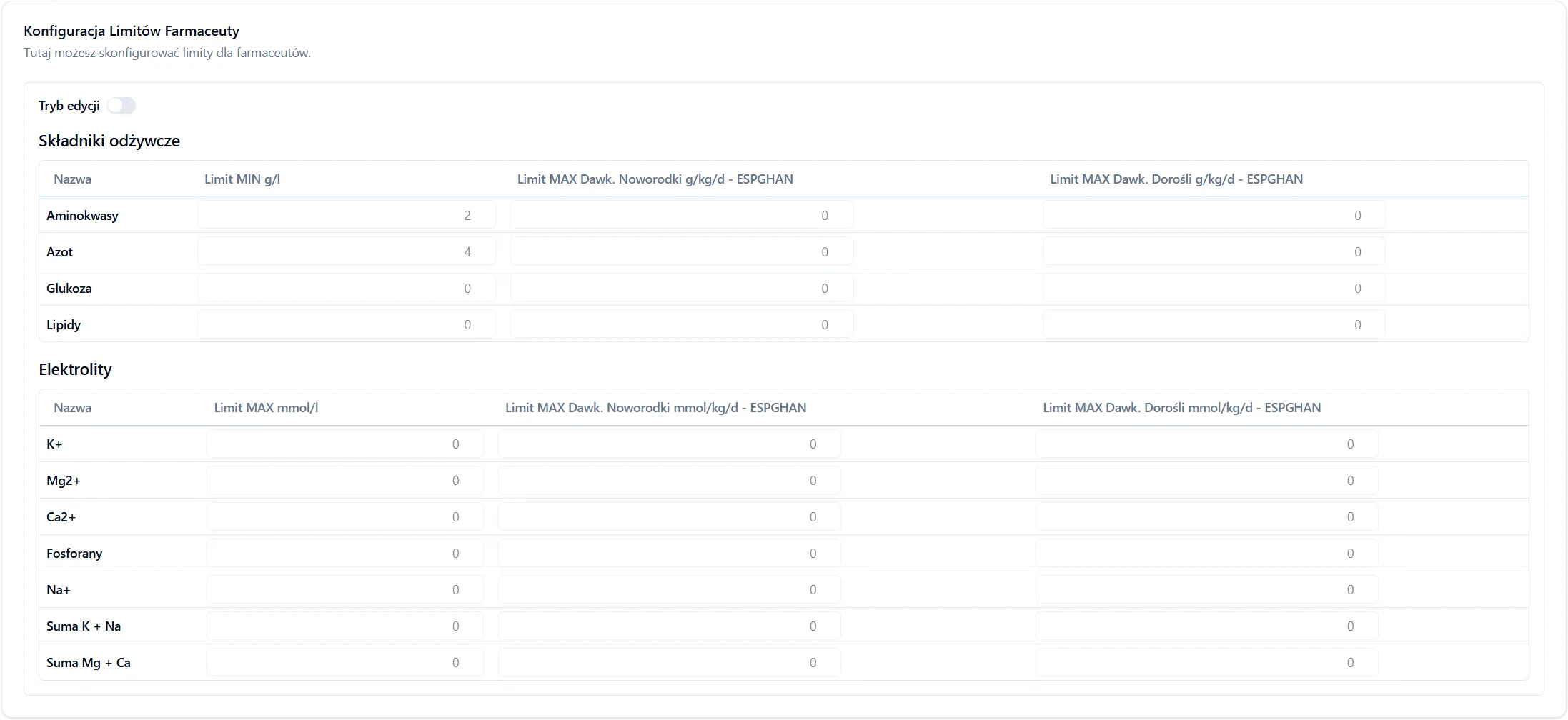
The configuration is divided into two main sections:
Nutrients
Section titled “Nutrients”In this section, you can configure limits for basic nutrients:
- Amino Acids – amino acid dosage range
- Nitrogen – nitrogen content range
- Glucose – glucose dosage range
- Lipids – lipid dosage range
For each nutrient, you can set:
- MIN Limit g/l – minimum value in grams per liter
- MAX Limit Dose Neonates g/kg/d - ESPGHAN – maximum dose for neonates in grams per kilogram of body weight per day (according to ESPGHAN guidelines)
- MAX Limit Dose Adults g/kg/d - ESPGHAN – maximum dose for adults in grams per kilogram of body weight per day (according to ESPGHAN guidelines)
Electrolytes
Section titled “Electrolytes”In this section, you can configure limits for electrolytes:
- K+ (Potassium)
- Mg2+ (Magnesium)
- Ca2+ (Calcium)
- Phosphates
- Na+ (Sodium)
- Sum K + Na – sum of potassium and sodium
- Sum Mg + Ca – sum of magnesium and calcium
For each electrolyte, you can set:
- MAX Limit mmol/l – maximum value in millimoles per liter
- MAX Limit Dose Neonates mmol/kg/d - ESPGHAN – maximum dose for neonates in millimoles per kilogram of body weight per day (according to ESPGHAN guidelines)
- MAX Limit Dose Adults mmol/kg/d - ESPGHAN – maximum dose for adults in millimoles per kilogram of body weight per day (according to ESPGHAN guidelines)
How It Works?
Section titled “How It Works?”- The pharmacist sets appropriate limits for nutrients and electrolytes in the configuration
- While working in the pharmacist view, in the verification tab, the system automatically compares the prescription values with the established limits
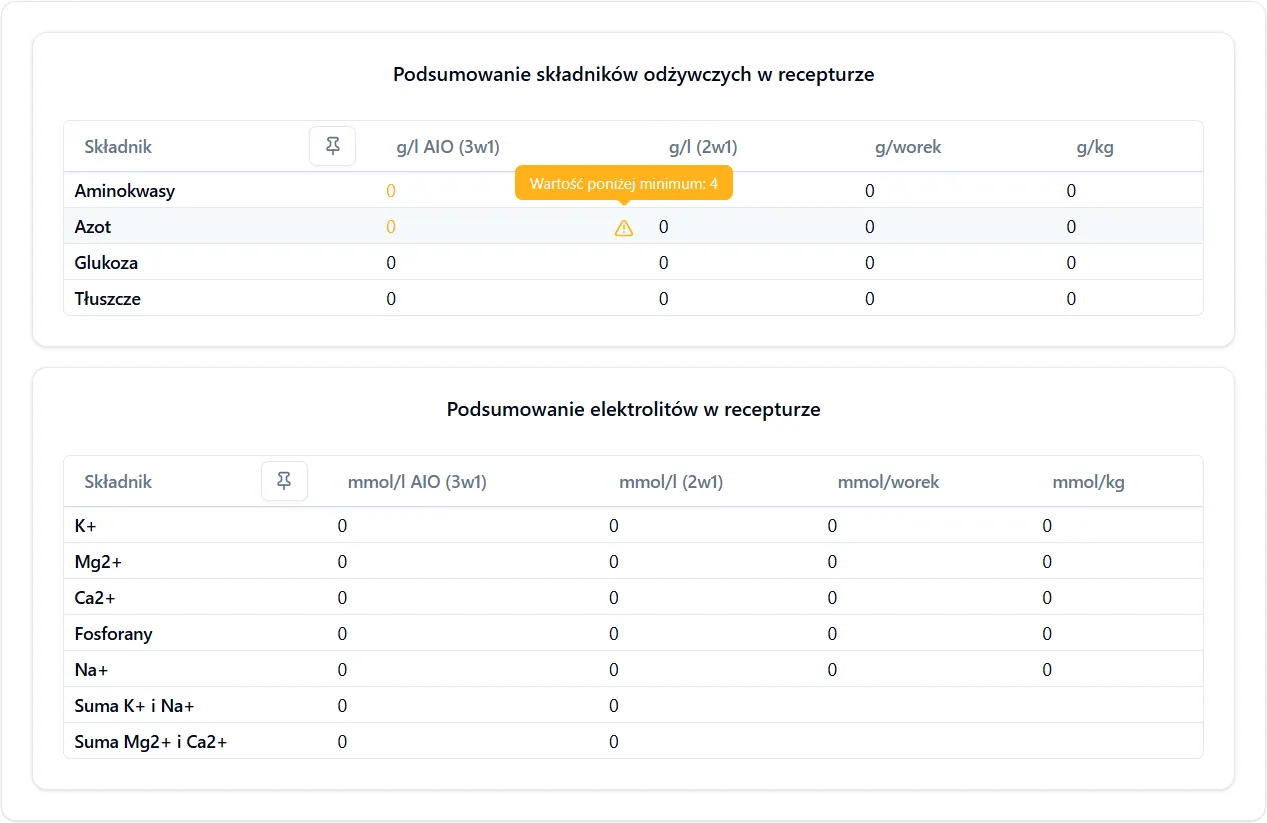
- Values exceeding the established limits are visually highlighted, making it easier for the pharmacist to quickly identify potential problems
- A warning icon appears next to values exceeding limits – hovering over it displays details of the exceedance (limit value, whether it’s too high or too low)
- The pharmacist can take appropriate action – accept the prescription or reject it for correction
Frequently Asked Questions
Section titled “Frequently Asked Questions”Are limits mandatory?
Limits are optional, but setting them significantly facilitates prescription verification and increases patient safety through automatic detection of atypical values.
Who can modify the limits?
Limits can be modified by any pharmacist with appropriate permissions to the pharmacist view. However, it is recommended that changes be consulted with the pharmacist team.
What happens when a value exceeds the limit?
The system will visually highlight the value in the verification tab in the pharmacist view. The pharmacist can still accept the prescription, but will be clearly informed about the limit exceedance.